Got a Surprise Medical Bill? When the No Surprises Act Protects You
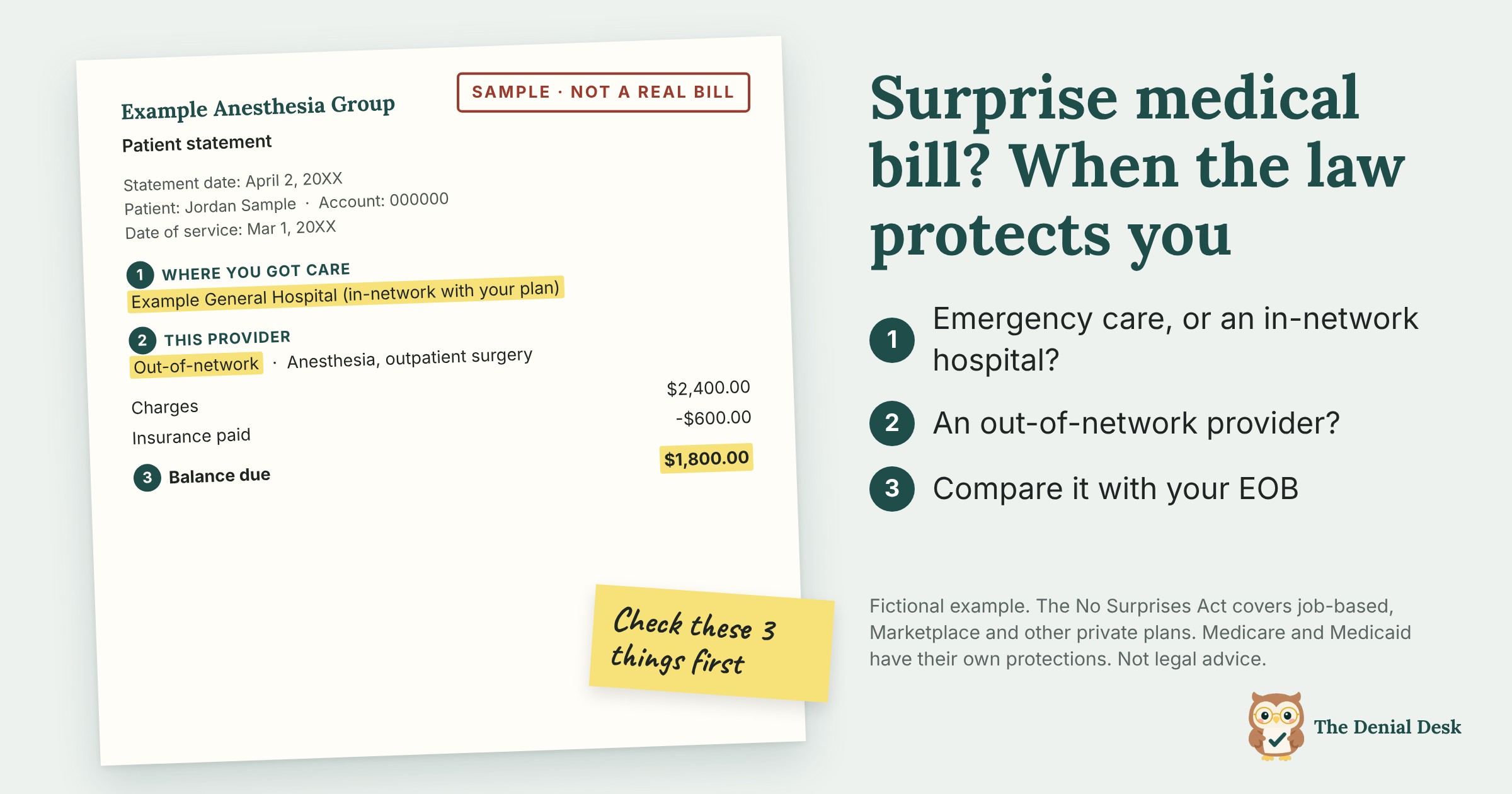
Got a big bill from a doctor or hospital you didn't choose? A federal law called the No Surprises Act may mean you don't owe it. Here's when it applies and what to do.
What the law covers
The No Surprises Act protects people with job-based, Marketplace, and other private health plans. Medicare and Medicaid have their own billing protections. These are the main protections, according to CMS (CMS: No Surprises Act protections):
- Emergency care. Out-of-network emergency care generally can't be billed above what you'd pay in network. Your plan also can't make you get approval first for emergency care.
- Out-of-network doctors at an in-network hospital. For most non-emergency care at an in-network hospital or surgery center, an out-of-network doctor, like an anesthesiologist, generally can't bill you more than your in-network share. For some planned care, a provider can ask you to sign a consent form giving up this protection. That's never allowed for emergency care before you're stable, or for anesthesiologists, radiologists, pathologists, and assistant surgeons. After you're stable, a hospital can ask you to sign one only in limited cases, such as when you could safely travel to an in-network hospital. You never have to sign it.
- Air ambulance. Covered helicopter and airplane ambulance services are protected too. Ground ambulances are not.
If you don't have insurance
If you're uninsured or paying on your own, providers have to give you a good faith estimate when you schedule care at least 3 business days ahead, or when you ask. If your bill ends up at least $400 more than the estimate, you may be able to dispute it. (CMS) Keep that estimate.
What to do with a surprise bill
- Don't pay it yet.
- Compare it to your Explanation of Benefits from your insurance.
- Call the billing office. Tell them you think the No Surprises Act applies, and ask them to rebill you at your in-network amount.
- If they won't fix it, call the No Surprises Help Desk at 1-800-985-3059. You can also contact your state insurance department. (CMS)
Keep notes on every call, with the date and the name of the person you spoke with.
If insurance is the problem
Sometimes the bill is high because your insurance denied the claim. Then you'll need to appeal the denial. The Insurance Denial Appeal Kit has letters for that, including one to dispute a surprise out-of-network bill.
For any bill that looks wrong
The Medical Bill Check Kit helps you check a bill against your EOB, dispute errors in writing, and keep track of every call. It has 7 letters, an 8-page guide, and a bill tracker.
Want to check every charge? Read this next: How to Get an Itemized Hospital Bill and Check It for Mistakes
Find every free guide and kit at The Denial Desk store.
This is general educational information, not legal or medical advice. Rules and deadlines vary by plan and state, so always follow the instructions on your own letters and notices. The Denial Desk is not affiliated with any insurer, hospital, or government agency.
AI disclosure: This post was drafted with help from AI tools, then reviewed and fact-checked by our founder, a certified medical coding professional.

Comments
Post a Comment
Please don't share medical details, bills, insurance numbers or other private information here. We can't review individual cases.